
Living in the Bishop Arts District: A Guide to North Oak Cliff's Walkable Core
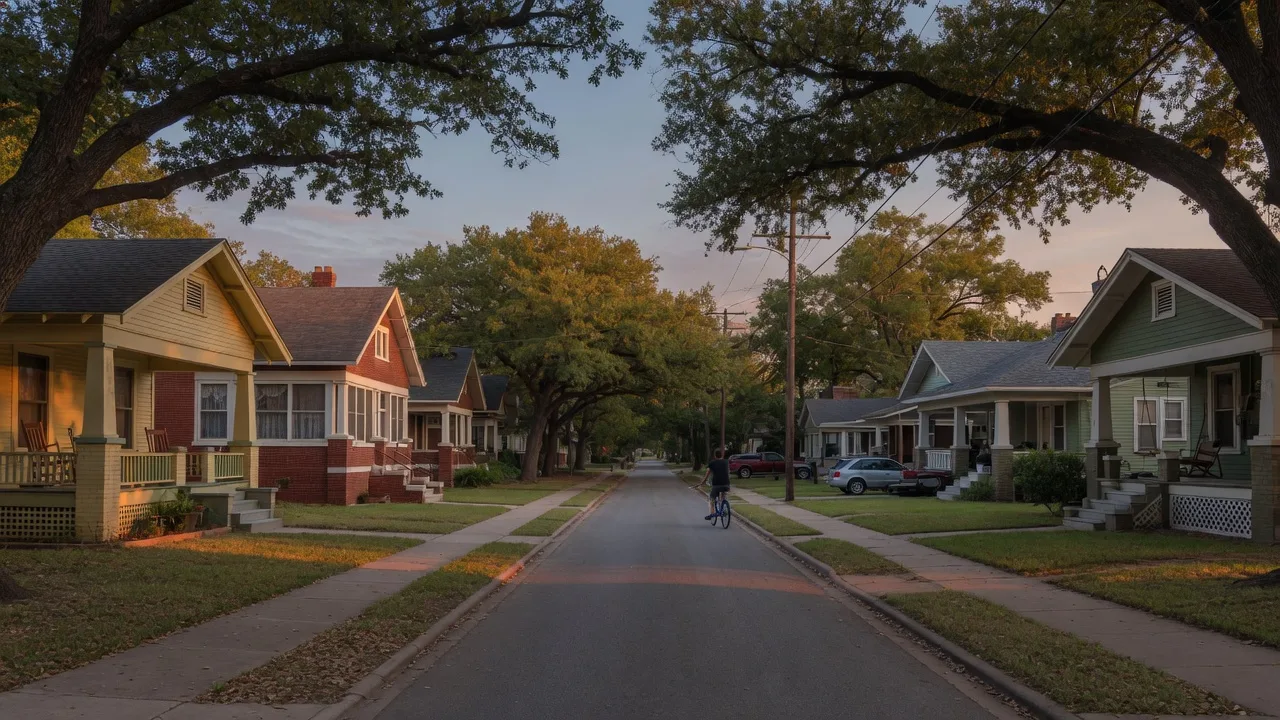
The Bishop Arts District is North Oak Cliff's walkable core, a roughly 49-square-block pocket centered on the intersection of North Bishop Avenue and Davis Street, about two miles southwest of downtown Dallas. More than 60 independently owned shops, restaurants, and galleries line the commercial strip, and the blocks around it hold early 20th century bungalows and newer townhomes. That mix is why it is one of the most interesting places to buy in the urban core. Here is what buyers and sellers should know before they start looking at Bishop Arts Dallas real estate.
I have been working North Oak Cliff since February 2000, and Bishop Arts is where I send buyers who want the walkability of Uptown without the high-rise feel. The neighborhood is small enough that block-to-block differences matter, and the protected commercial core gives it a character no other Dallas neighborhood quite matches. This guide covers where the district sits, how it got its name, what the housing stock looks like, how the conservation district rules work, and what the market is doing at the end of 2026.
Where the Bishop Arts District Sits
The commercial heart of the district anchors at North Bishop Avenue and Davis Street, which carries State Highway 180 as it crosses Oak Cliff. Addresses here fall in the 75208 ZIP code, and the surrounding North Oak Cliff neighborhoods, Winnetka Heights to the north, Kessler Park to the south, are part of the same postal area. The district itself is a compact pocket of roughly 49 square blocks, sometimes measured at under a fifth of a square mile, with an estimated 1,500 to 2,000 residents.
The official boundaries were set in 1992, when the City of Dallas created the Bishop Arts Conservation District, formally Conservation District No. 7. The border streets you will see on city maps are roughly Seventh Street on the north, Melba on the east, and Llewellyn and Zang wrapping the south and west. A portion of the commercial strip, the North Bishop Avenue Commercial Historic District, is also listed on the National Register of Historic Places. When I describe Bishop Arts to out-of-town buyers, I tell them to picture the densest, most walkable block of a small town dropped into the middle of a city neighborhood: that is the scale we are talking about.
From a Streetcar Stop to the Arts District
The district grew up as a streetcar suburb. Oak Cliff was annexed into Dallas in 1903, the streetcar line reached the area in 1904, and the stop at Bishop and Davis became one of the busiest in the city by the 1930s. Shops, warehouses, and small commercial buildings filled in through the 1920s and 1930s, which is why the storefronts you see today are genuine period architecture rather than re-creations. The Bishop Arts Theatre Center occupies a building erected between 1914 and 1917 that started life as a silent-era movie house.
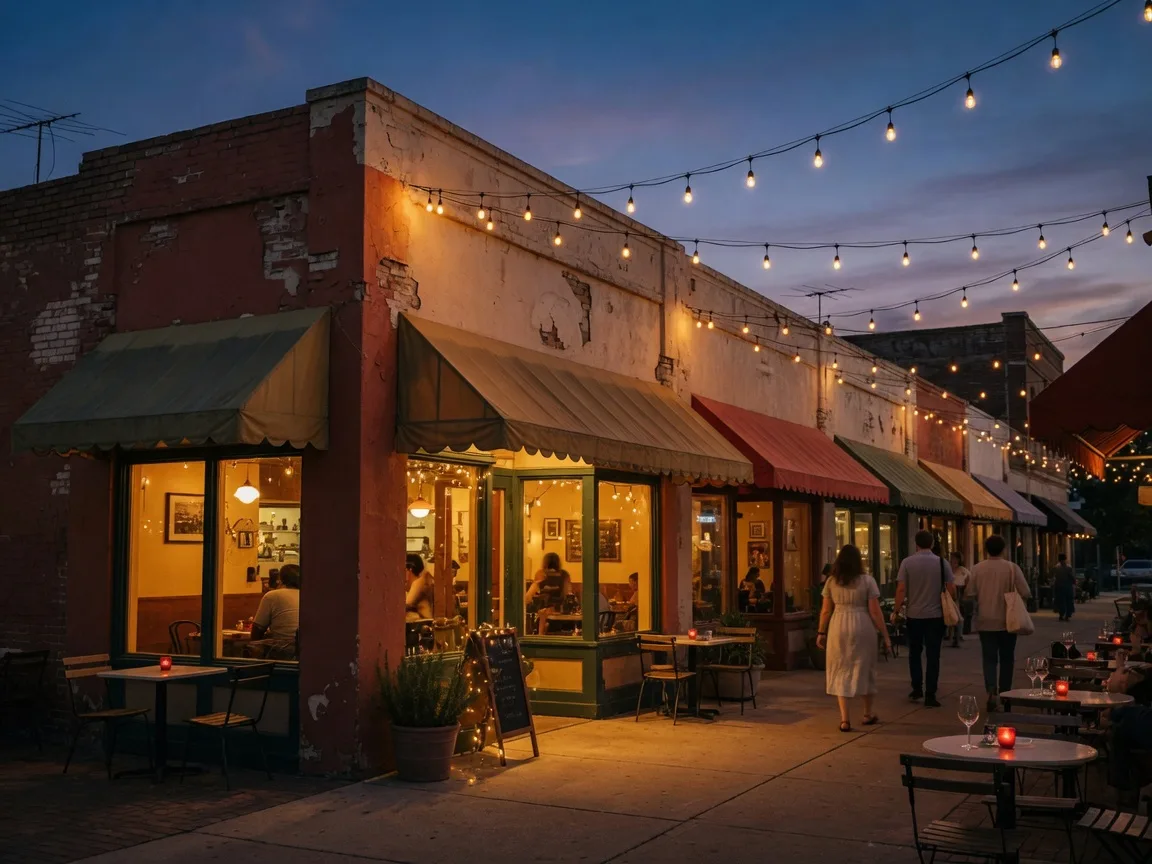
Like much of old Oak Cliff, the district went through a long decline from the mid-1960s into the early 1980s as suburban malls pulled shoppers and anchor stores away. What saved it was the same thing that made it: cheap empty storefronts attracted artists in the 1970s, and developer Jim Lake is credited with coining the name Bishop Arts District. The city followed with street, sidewalk, and landscaping improvements, and today the strip is the strongest commercial district in North Oak Cliff. It has earned a reputation as Dallas's most independent neighborhood, with more than 60 independently owned businesses and no two storefronts alike. Weekend evenings here are busy in a good way, and the foot traffic is exactly what the surrounding residential blocks sell on.
The Housing Stock: Bungalows, Townhomes, and New Construction
The commercial core is the showpiece, but the real estate story is the housing around it. In the blocks closest to Bishop and Davis you find early 20th century houses: Craftsman bungalows, four-squares, and cottage styles with deep porches and original woodwork, many of them thoughtfully renovated over the past two decades. A few steps further out, the mix broadens to include mid-century ranch houses and modest post-war homes on tree-lined streets.
New construction has also been filling vacant lots in recent years: townhomes, duplexes, and rowhouse-style buildings tucked in among the older houses, plus a wave of new apartments within a few blocks of the strip. That development pressure is the clearest signal the district has changed, and it is worth understanding before you buy.
Be honest with yourself about one thing before you start: Bishop Arts is not a high-rise condo market. If your search is specifically for condos in Dallas with an elevator and a parking garage, Uptown and the Turtle Creek corridor are where that product lives. The traditional condo inventory in and immediately around Bishop Arts is thin, and most of the new multifamily nearby is rental. New construction for buyers here usually means townhomes, and the resale market is dominated by single-family houses. That is not a drawback, it is the character of the place, but it changes how you should search. My North Oak Cliff buying guide walks through the range of property types across the neighborhood, including the townhome pockets near the district.
What the Market Looks Like at the End of 2026
Market data for a pocket this small varies by source, so here is the honest range rather than a single number. Redfin's neighborhood data for Bishop Arts puts the median sale price around $550,000, down roughly 4% from a year earlier, with the median price per square foot around $241. The broader 75208 ZIP code, which covers the district and most of surrounding North Oak Cliff, shows a median sale price of $564,872 for the three months ending in June 2026, down 13.1% year over year at $261 per square foot, according to Redfin data as analyzed by Grey Square. Other 2026 estimates cluster in the high-$400,000s to low-$500,000s for the district itself.
The decline in the headline numbers deserves context. Analysts attribute much of it to a mix shift: more lower-priced sales and new builds closing this year rather than values falling across the board. The texture underneath is more interesting. About 46% of 75208 listings cut their asking price at some point in mid-2026, and Bishop Arts homes averaged roughly 88 to 96 days on market, notably slower than wider North Oak Cliff, which ran about 49 days. The days of multiple offers on everything are not the norm here right now.
What that means in practical terms: buyers have real negotiating room, and sellers need a realistic price from day one. Entry points into the district's oldest houses start below the median when a home needs work, while renovated bungalows and new townhomes sell comfortably above it. Prices are not uniform block to block, which is exactly why the tour strategy in the last section of this guide matters. The wider North Oak Cliff numbers, including Kessler Park at the top of the market, are in my North Oak Cliff market update.
Daily Life: Walk to Coffee, Ride the Streetcar Downtown
Walkability is the reason most people look here, and it holds up in daily use. The strip on Bishop runs from Davis down past Seventh, and most of the neighborhood's errands and meals sit within a short walk of the residential blocks. On a typical morning the sidewalks fill with people moving between coffee and the day's plans, and on weekend evenings the restaurants do the same. The long-running Eno's Pizza Tavern and Veracruz Cafe anchor opposite ends of the strip, with Tejas, Hunky's, and Gloria's Latin Cuisine between them. Cafe Brazil and Whisk Crepes Cafe cover the coffee-and-breakfast end, and Norma's Cafe on Davis has been an Oak Cliff institution for generations.
The district also has its own culture circuit. The Bishop Arts Theatre Center on Tyler Street runs theater, music, and community programming from that 1914 to 1917-era building, and the Texas Theatre a few minutes west on West Jefferson Boulevard is an operating independent cinema, famous as the site where Lee Harvey Oswald was arrested on November 22, 1963. For getting downtown without finding parking, the Dallas Streetcar runs free every 20 minutes, seven days a week, on a 2.45-mile line connecting the Historic Bishop Arts District to Union Station downtown.
The Conservation District Rules and What They Mean for You
The character you are paying for is protected, and that protection is a real part of the value. The 1992 ordinance that created the Bishop Arts Conservation District set the review requirements for the area: exterior changes to contributing properties, including storefront work, signage, and renovations on the blocks governed by the district, go through the city's review process, and demolition and new construction are limited by the same rules. It is the reason the commercial strip still looks like a 1930s shopping street instead of a strip center.
For buyers the practical version is simple: before you plan exterior work on a house or commercial space here, check the district status of the specific address with the City of Dallas and build the approval step into your timeline and budget. Interior work is your own; roof lines, storefronts, facades, windows, and signage are where the review applies. I talk through this constantly with both buyers and sellers, because the rules that feel restrictive at first are the same rules that protect resale value across the whole district.
Parking, Crowds, and the Practical Details Buyers Forget
Go to the district on a weekend evening and you will see it at full strength, and you will also see the parking picture with your own eyes. Street parking around Bishop and Davis fills up on busy nights, and the residential blocks around the strip absorb overflow. That is a normal trade for the most walkable neighborhood in North Oak Cliff, and the free streetcar to downtown helps, but it is worth knowing before you commit. Buyers coming from suburban settings should plan for it; buyers leaving Uptown will find it familiar.
My standing advice for anyone considering this neighborhood is to visit the specific block you are looking at twice: once on a quiet weekday morning and once on a weekend evening. The weekday visit shows you the commute, the parking on a normal day, and the pace of daily life. The weekend visit shows you what it is like to live steps from a busy commercial district. Both are true, and the right buyer wants both. If either visit surprises you, that is the answer you were after.
Who the Bishop Arts District Works For
Bishop Arts works for buyers who want walkable urban life with a neighborhood feel: first-time buyers who want a real house with character and a short walk to dinner, downsizers who want less yard and more daily life, and buyers who want new townhomes steps from the strip rather than a high-rise lobby. It also works for people who value the fact that the commercial district is protected, because that is what keeps the neighborhood from changing into something generic.
It is not the right fit if you want a large yard well away from foot traffic, if you want high-rise amenities like a pool and a concierge, or if a busy sidewalk on a Saturday night bothers you. Those buyers are better served in the quieter blocks deeper in North Oak Cliff, or in the high-rise corridors of Uptown and Turtle Creek, and I am glad to point them that way too.
How I Would Start the Search
Start the same way I do: park and walk. Give yourself an afternoon to cover the blocks between Bishop and Tyler and between Davis and Eighth, look at what is actually on the market, and ask what the conservation district rules mean for each specific house you like. The differences between a renovated bungalow one block off the strip and a townhome two blocks further out matter in ways a search portal will not show you.
The North Oak Cliff buying guide and the North Oak Cliff neighborhood overview cover the wider picture, and I will walk the current Bishop Arts inventory with you whenever you are ready. Send me a note and we will look at real houses, not just the map.
Talk soon!