
Living in Victory Park: A Guide to Uptown Dallas's Arena District
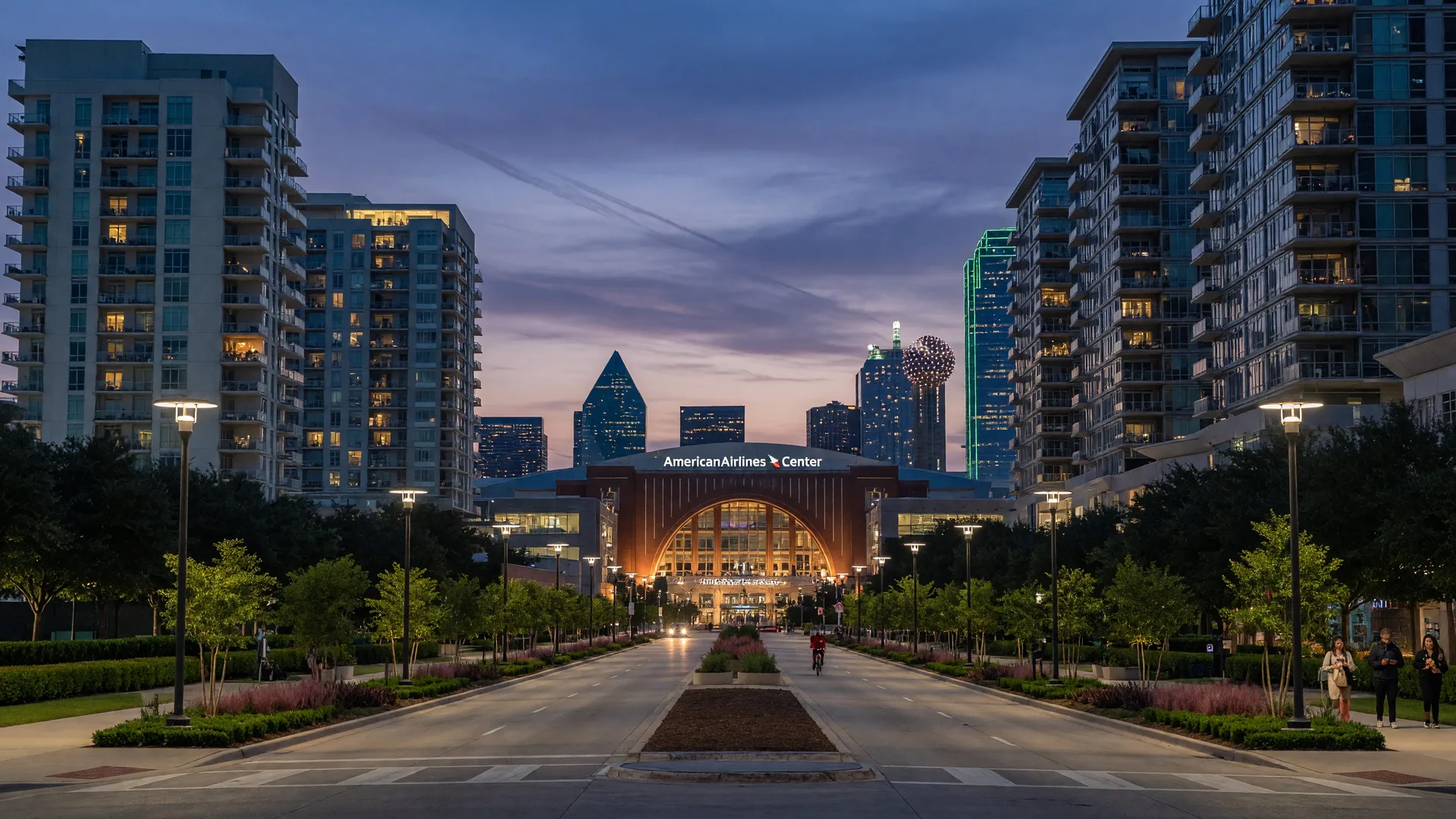
Victory Park is the master-planned district that grew up around the American Airlines Center, sitting in the gap between Downtown and Uptown Dallas. For buyers looking at Uptown Dallas condos, it is the pocket most people know by name from game nights and concerts, but rarely consider as a place to live. That is worth fixing, because the arena district has one of the most distinctive housing markets in the urban core: high-rise condos, a real transit hub, and the Katy Trail at its edge.
I have been working the Dallas urban core since 2000, and Victory Park has changed more in that time than almost any other neighborhood I cover. It went from rail yards to a roughly $3 billion mixed-use district in about two decades. Here is what a buyer should actually know before they start looking at condos here, including the honest late-2026 market picture.
Where Victory Park Sits and What Bounds It
Victory Park is a compact, roughly 75-acre master-planned district just northwest of downtown, on the other side of the Woodall Rodgers Freeway from the Arts District. It sits along the I-35E corridor in the space between Downtown and Uptown, which is what makes its location so unusual: you are adjacent to downtown's museums and offices, a short walk from Uptown's McKinney Avenue dining, and minutes from the Design District.
The neighborhood is small enough that nearly everything in it is walkable. The American Airlines Center anchors the north end. The Perot Museum of Nature and Science sits at the southern edge, and Klyde Warren Park is a short walk across the Woodall Rodgers bridge. The Katy Trail, the 3.5-mile rail corridor that runs south to Mockingbird Lane, starts at the district's edge. For buyers comparing Uptown Dallas condos, Victory Park offers the most concentrated version of that walkable, event-driven lifestyle.
The Arena District's Short, Purposeful History
Victory Park was not a gradual neighborhood. It was planned. The site was a former rail yard, and the anchor that changed everything was the American Airlines Center, which opened at 2500 Victory Avenue in July 2001. The arena is owned by the City of Dallas, seats roughly 19,000 to 21,000 depending on the event, and is home to the Dallas Mavericks and the Dallas Stars, along with a steady concert calendar.
The roughly $3 billion master plan filled in around it over the following decades: offices, hotels, retail, restaurants, and residential high-rises. That history matters to a buyer, because it explains the trade-offs. The streetscapes, parks, and amenities here are deliberate and well maintained. But the residential stock is newer and thinner than in Uptown's older neighborhoods, and there is less of the organic, block-by-block character you find in places like State Thomas.
The Housing Stock: High-Rise Condos and Lofts
Victory Park is a high-rise market, and the condo supply concentrates in a handful of buildings. Two stand out for buyers I work with:
The House at 2200 Victory Avenue is a 28-story tower built in 2008 and designed by Philippe Starck, with 133 condominium units ranging from one to three bedrooms. It has the design pedigree, the views, and the lobby-to-amenities package that draws buyers who want the full high-rise experience. Listings at The House have ranged from the mid-$300,000s into seven figures, which gives the district real entry points for buyers who assumed Uptown high-rises were out of reach.
The Cirque at 2500 North Houston Street is also a 28-story tower from 2008, with 252 units, concierge service, and units that run from about 700 square feet up to roughly 2,400. It is the building buyers most often compare to The House, and the choice usually comes down to unit layout and view orientation rather than the neighborhood, since they sit within blocks of each other.
What you pay for in both buildings is the same thing: position, views, security, and a maintenance package where the HOA handles the shared systems. High-rise HOA fees in Dallas are real money, and they cover the kind of costs a single-family owner never sees, so the same HOA due diligence applies here as everywhere in the urban core. The same condo financing rules apply too: a building needs to meet conventional requirements on owner-occupancy, reserves, and litigation before most lenders will touch it, and I check that before a client falls in love with a unit.
What the Market Looks Like Here in Late 2026
Victory Park is a smaller, slower-moving market than Uptown proper, and right now that works in a buyer's favor. Recent sale data shows condos averaging roughly 110 days on market, meaningfully longer than the well-priced units in the rest of Uptown. That is not a sign of weakness in the district. It is a sign of a thinner buyer pool in a building-heavy pocket, and it translates into negotiating room for people who come prepared.
Price per square foot has run roughly $600 to $650 in recent sales, with average sale prices around $1.1 million. Median prices have trended up over the past year even as the market has cooled, which is typical for a district with limited inventory and a lot of new supply in the buildings around it. The practical takeaway for buyers: take the extra days on market as time to compare buildings, review the HOA documents properly, and make an offer with confidence rather than urgency. My full write-up on the Uptown Dallas condo market has the neighborhood context this district fits into.
Daily Life: Coffee, Food, and the Arena Calendar
Victory Park has a real daily life between the events, and it is more self-contained than most people expect. Coffee is Pax & Beneficia at 1775 Payne Street or Hatchways Café at 2346 Victory Park Lane, both within a few minutes' walk of the residential towers. For food, the Victory Park Lane strip holds Billy Can Can, Black Tap Craft Burgers & Beer, and Roti Grill, so a weeknight dinner rarely requires a car.
The honest caveat is groceries. The district itself does not have a full-service grocery store, so most residents use the larger markets a short drive or ride away in Uptown and downtown, or rely on delivery. It is the same trade-off you accept in most dense urban districts, and buyers coming from a house should budget for it. What the district gives back is the Perot Museum, Klyde Warren Park, and the Katy Trail all within a short walk, which is a daily-life math that favors a lot of the buyers I work with.
Event Nights: What Buyers Should Actually Understand
The American Airlines Center hosts the Mavericks, the Stars, and a year-round concert calendar, which means a lot of event nights. On those nights the neighborhood changes: streets around the arena close to traffic, restaurants fill up, and the walk from the arena back to your building is part of the appeal for residents. For buyers, the question is simple. If the energy of game night is something you want to walk into, proximity to Victory Avenue is the amenity. If you want quiet, choose a unit on the side of the building away from the arena and accept that event nights come with the district.
This is also why Victory Park suits a specific kind of buyer: someone who wants a low-maintenance home in the middle of the action, with the option to host guests at games and concerts without anyone driving. If you want a quiet historic street instead, Uptown's quieter pockets and Oak Lawn are a better fit, and we can compare them directly.
Getting Around: DART, the Katy Trail, and Downtown on Foot
Victory Park may be the best-transit-connected residential district in the Dallas urban core. Victory Station, on the west side of the American Airlines Center, serves DART's Green and Orange light-rail lines plus the Trinity Railway Express to Fort Worth, opened in 2004 and built for arena crowds. That means downtown, the airport, and Fort Worth are all reachable without a car, which matters for buyers relocating from out of state or commuting downtown.
On foot, the Woodall Rodgers bridge puts you in the Arts District and Klyde Warren Park in minutes, and the Katy Trail starts right at the district's edge and runs 3.5 miles south to Mockingbird Lane. If you are weighing buying a condo in Dallas between Victory Park and the rest of Uptown, spend a morning here: coffee at Pax & Beneficia, a walk down the trail, and a loop through the residential towers. The district either clicks with you or it does not, and it is fast to tell which.
Is Victory Park Right for You?
Victory Park works best for buyers who want the urban core's most concentrated version of arena-district living: downtown workers, sports and concert fans, empty nesters who want a lock-and-leave high-rise, and relocating buyers who want to land somewhere with transit and walkability already in place. It is a thinner market with slower days on market, which is exactly why it rewards a buyer who does the homework instead of rushing.
If you are comparing neighborhoods, start with the Uptown neighborhood guide to see how the arena district fits alongside State Thomas, McKinney Avenue, and the rest of Uptown. Then get in touch, and I will walk the current Victory Park inventory with you, review the building documents, and tell you honestly which units are worth your time and which are not. That is the way I have worked for more than 25 years in these neighborhoods, and it has not changed.
Talk soon!