
Living in Stevens Park Village: A Guide to North Oak Cliff's Historic Neighborhood by the Golf Course
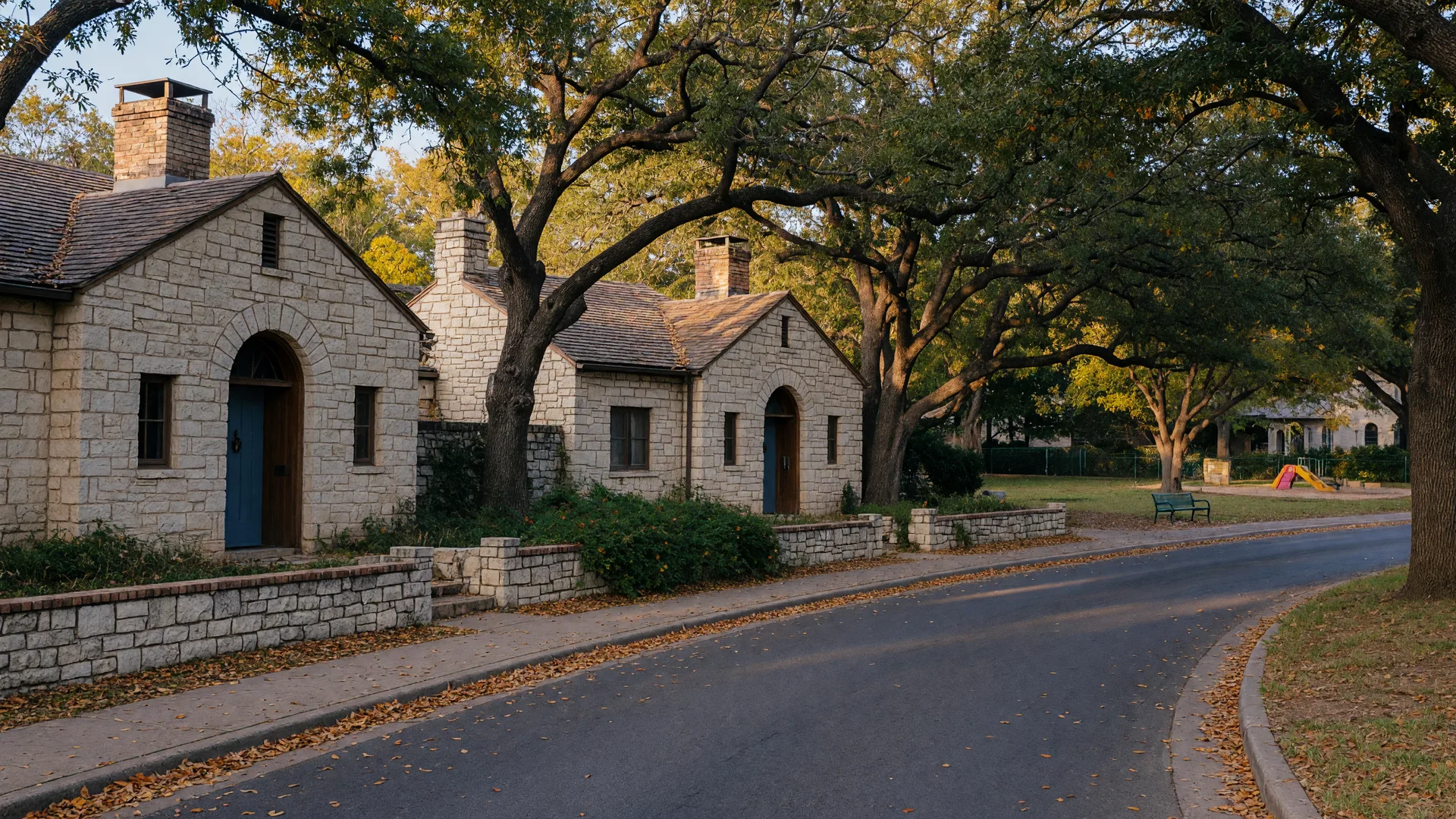
Stevens Park Village is one of North Oak Cliff's smallest and most intact historic pockets, a compact neighborhood of roughly 137 homes arranged around the municipal golf course that shares its name. The housing was built mostly between 1939 and 1961, which means you are looking at Austin stone cottages, brick bungalows, and mid-century ranches on curving, tree-lined streets about six miles from downtown Dallas. It is also the only North Oak Cliff neighborhood to become a conservation district in 2026, which tells you a lot about how much the people who live here care about how the streets look.
I have worked the North Oak Cliff market since February 2000, and Stevens Park Village is the neighborhood I send people to when they want a real house in the urban core, a yard, and a price that does not come with a Kessler Park premium. If you have spent time in my condo guides, this pocket solves the opposite problem: there is no HOA fee to budget for here, just a set of neighborhood rules that protect the character. Here is what I would look at before you start touring Stevens Park Village homes for sale.
Where Stevens Park Village Sits
The neighborhood sits in the southwest part of North Oak Cliff, just off the Fort Worth Avenue and Hampton Road intersection. The commonly cited boundaries are Remond Drive on the north, North Hampton Road on the east, Fullerton Drive on the west, and Fort Worth Avenue on the south. From most of the village, downtown Dallas is about six miles northeast, the Bishop Arts District is roughly three miles away, and the Dallas Zoo in Marsalis Park is a straight shot up the road.
The real anchor of the location is the golf course. Stevens Park Golf Course wraps around the east and south edges of the neighborhood, which is why the curving streets feel so private. You get the North Oak Cliff identity, the trees, and the community without the visitor traffic of Bishop Arts, and you stay close enough to downtown that a commute is genuinely practical. For buyers comparing North Oak Cliff real estate, Stevens Park Village is the quiet middle ground between the historic peaks of Kessler Park and the busy commercial core around Davis Street.
From La Réunion to a Mid-Century Village
The land under Stevens Park Village has a longer story than most Dallas addresses. It was part of the grounds of La Réunion, the short-lived utopian settlement that French, Swiss, and Belgian colonists founded on the other side of the river in 1855. That experiment lasted only a few years, but its presence is why this part of Dallas has a distinct history from the streets that grew up around downtown.
The modern neighborhood is the work of developer John P. Stevens, who opened the village in 1939. The first homes, on Colorado, Lawndale, Barberry, Leander, and Walter Drive, went up between 1939 and 1941. A western addition along Stevens Ridge, Stevens Crest, and Fullerton followed in the 1950s and 1960s with larger ranch homes. Along the way, Dallas architect Charles Dilbeck, the designer behind much of the city's mid-century residential look, drew plans for 15 of the houses in the village, which is an extraordinary concentration for a neighborhood this size.
The Housing Stock: Austin Stone Cottages and Mid-Century Ranches
With roughly 137 properties, Stevens Park Village is a small market, and the housing breaks into two eras. The 1939-1941 core is dominated by Austin stone and brick cottage-style homes, mostly in the 1,000 to 1,500 square foot range, with hardwood floors, fireplaces, arched openings, corner cupboards, and chair rail molding. The western addition trades those details for larger mid-century ranch houses on streets like Stevens Ridge and Stevens Crest.
What unifies the whole village is the street design. The roads curve instead of grid, the lots are generously sized for the area, and several blocks end in small circular play parks. Drive through on a weekday afternoon and you will see what I mean: it feels nothing like the newer grid subdivisions, and that is the point. Local preservation groups have kept detailed histories of the village's homes, and the Heritage Oak Cliff profile is a good place to start if you want the street-by-street story.

Oak Cliff's Newest Conservation District
In June 2026, Stevens Park Village became Oak Cliff's ninth conservation district, designated Conservation District No. 22 by the City of Dallas. The designation covers a roughly 39.7-acre core of the neighborhood, and it did not happen overnight: a group of 11 neighbors started the effort in May 2022 and carried it through the city process for four years.
What that means for buyers is simple to state. A conservation district is not an HOA. There are no dues and no board meetings. Instead, exterior changes, additions, and new construction go through a public review so that the character of the street survives. The ordinance was even amended during passage to allow accessory dwelling units to be rented as income property, which makes the village one of the more flexible historic districts in Dallas if you are thinking about a garage apartment or a backyard unit.
For sellers, the designation is worth understanding before you plan exterior work, because a new roof, windows, or an addition may need approval. The Oak Cliff Advocate's coverage of the designation lays out the process in plain terms. For buyers, the takeaway is that the exact streets you are falling for are protected from being changed by the next owner, which is precisely what holds values steady in a neighborhood this small.
Daily Life at the Edge of the Fairway
The centerpiece amenity is Stevens Park Golf Course at 1005 North Montclair, a public, municipally owned 18-hole course that local players have nicknamed the Little Augusta of North Texas. It is par 70, stretches about 6,285 yards, and has been a Dallas institution since it opened in the 1920s, with a redesign over the years that keeps it among the most popular public courses in the metro. You do not have to play to enjoy it; the course doubles as the neighborhood's back yard, and the City of Dallas parks page has the tee times and details.
Daily errands run up the road to Davis Street, North Oak Cliff's main commercial spine. Morning coffee is Oak Cliff Coffee Roasters or Wayward Coffee Co., and a plate of diner food at Norma's Cafe at 1123 West Davis has been a neighborhood institution for decades. For dinner, Nova and Cretia's are both a short drive, and the Bishop Arts District's restaurants and shops are about three miles east. The North Oak Cliff dining and things to do guide covers the wider area if you want the full list.
What the Market Looks Like in Late 2026
This is a deliberately small market, so read the numbers with that in mind. Public data through late 2026 shows a median sale price around $520,000 for Stevens Park Village, with recent closed sales ranging roughly from $415,000 into the mid-$600,000s and prices around $290 per square foot. A 2026 Dallas market guide describes village homes trading from the $500,000s up into seven figures, which tells you the range runs wider than the median suggests.
For context, my North Oak Cliff market update puts the broader 12-month median for the whole neighborhood around $395,000, so Stevens Park Village sits meaningfully above the area average, driven by the lot sizes, the golf course setting, and the scarcity of listings. Expect fewer than a handful of homes on the market at any given time. When something well-priced comes to market it moves fast, and when something is overpriced it sits, because the buyer pool is small enough that pricing mistakes get punished. Condition spreads the price wide: an original 1940 cottage and a fully renovated one are different products on the same street.
Schools: The Pinkston Feeder Pattern
Stevens Park Village is served by Dallas ISD in the Pinkston feeder pattern. The neighborhood elementary school is Stevens Park Elementary at 2615 West Colorado Boulevard, a pre-K through sixth grade campus, feeding into Raul Quintanilla Sr. Middle School STEAM Academy and then Dr. L. G. Pinkston Sr. High School.
Attendance zones can shift, so I always tell buyers with school-age kids to confirm the assignment for the exact address with the Dallas ISD school finder rather than assume. A house on one side of a boundary can feed a different campus than a house on the other.
What to Check Before Buying in Stevens Park Village
The houses are old, so the due diligence list starts with the bones. Get a full inspection and pay particular attention to the foundation, which is the biggest variable on an 80-year-old Dallas house sitting on the region's clay soils, along with the roof, the HVAC, and the age of the electrical panel and plumbing. Walk the property after a hard rain if you can, because drainage and grading matter on gently sloping lots.
If you are buying with an accessory dwelling unit in mind, do not assume an existing structure is legal. Confirm what is permitted, what is grandfathered, and what the conservation district requires before you count rental income in your numbers. And if you plan exterior changes, budget the review process into your timeline; it is a feature of this neighborhood, not a surprise you want to hit after closing.
Who Stevens Park Village Works For
Stevens Park Village fits first-time buyers who want a real house and a yard in the urban core at a more accessible price than Kessler Park, buyers who want to be near the city without living on top of it, and anyone who thinks mornings on the golf course are a good reason to buy. It is also a sensible stop for empty nesters leaving an Oak Lawn condo who still want the North Oak Cliff identity but are done with HOA fees. My North Oak Cliff buying guide walks through how the pockets compare.
It is not the right fit if you want a new-build house with nothing to fix, a strict school assignment outside the Pinkston feeder, or a strictly walkable no-car life. For that last one, the Uptown buying guide is the better starting point. But for the buyer who wants North Oak Cliff's character on a tree-lined curve with a real lawn, Stevens Park Village is where I would point you first. The Kessler Park guide covers the higher end of the same argument, and the Elmwood guide shows the village's quieter neighbor.
How I Would Start the Search
Start the way I do: get coffee at Oak Cliff Coffee Roasters, drive Fort Worth Avenue to Hampton, then take the loops through the village at dusk when people are home. Walk the circular play parks, walk a hole or two of the course if the light is right, and notice which streets you slow down on. The difference between a renovated Dilbeck cottage and an original fixer, and between a quiet loop and a through-street, is something a listing photo will not show you.
The North Oak Cliff neighborhood overview and the story of how I work cover the wider picture, and I am glad to walk the current Stevens Park Village inventory with you whenever you are ready. Send me a note and we will look at real houses, not just the listings.
Talk soon!